Delux Old & New Testament Edition
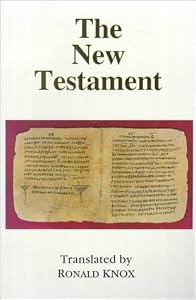
New Testament only; Paperback
|
The Knox Bible - translated from the Latin Vulgate to contemporary English
A living, dynamic, modern and scholarly translation of the Latin Vulgate into a beautiful and highly readable and
clear prose.
- Maintains the distinction of second personal singular and plural. Traditionally translated as "Thee" and "You"
in English, the singular and plural versions of the 2nd person pronoun
have very distinct meanings. The former is used between friends,
lovers, family, close peers, and 'buds'; much like the Spanish
"Tu".
The plural "You"
was used in formal occasions, when addressing royalty or
respected groups. Jesus chose his words carefully and for a
reason. This distinction is present in the original languages, but has
been erased in almost all modern bible translations. Although
the Knox translation is in twentieth century English, this distinction
is preserved.
- Based on the Vulgate and Septuagint. Most modern
translations are based on a reconstructed "original" version
of the scriptures. But this modern reconstruction and excising
was done centuries after the time of Christ. If you want to read
the complete Old Testament that Jesus Himself read, knew, and quoted, you need a
translation based on the Septuagint and/or the Vulgate.
- Highly readable and clear in an enjoyable English.
Some excerpts (including the occasional footnote):
"And the Lord God said to the serpent, For this work of thine,
thou, alone among all the cattle and all the wild beasts, shalt bear a
curse; thou shalt crawl on thy belly and eat dust all thy life
long. And I will establish a feud between thee and the woman,
between thy offspring and hers; she is to crush thy head, while thou
dost lie in ambush at her heels.1
Genesis 3:14-15
1 For 'she' and 'her' the Septuagint
Greek has 'he' and 'his'; the Hebrew text also, as it has come down to
us, gives 'he', or perhaps 'it'. But most manuscripts of the Latin
version have 'she', which plainly gives a better balance to the
sentence. That the reference of this passage, in any case, is to the
Incarnation, is the general opinion of the Fathers. The Latin here
assumes that there is a play upon words in the original, since there
are two Hebrew verbs closely alike, one of which means 'to crush', and
the other 'to follow eagerly'. But the Hebrew text has 'to crush' in
both clauses; the Septuagint Greek, in both clauses, has 'to lie in
wait'.
"Sign you ask none, but sign the Lord will give you. Maid shall
be with child, and shall bear a son,5 that
shall be called Emmanuel."
Isais 7:14
5 Literally, the verse begins
'Therefore, the Lord, he will give you a sign'. 'Maid shall be with
child'; cf, Mt. I.23. The Hebrew text, but not the Greek, would admit
'a maid' instead of 'the maid'. In the Hebrew text, the word used
should perhaps be translated 'maid' rather than 'virgin' since it
refers rather to a time than a state of life; but in view of the
event, we cannot doubt that this prophecy looks forward to the Virgin
Birth. [...]
"Do not think that I have come to set aside the law and the prophets; I have
not come to set them aside, but to bring them to perfection."
Matthew 5:17
"This, then, is to be your prayer, Our Father, who art in heaven,
hallowed by thy name; thy kingdom come; thy will be done, on earth as
it is in heaven; give us this day our daily bread;5 and forgive us our
trespasses, as we forgive them that trespass against us; and lead us
not into temptation, but deliver us from evil. Amen." Matthew 6:9-13
5 'Daily': the Latin here (but not in
Lk. II.3) coins the word supersubstantialis, which has
sometimes been understood as a direct reference to the Holy Eucharist.
more excerpts
NOW
ON SALE
Hardcover Complete Holy Bible (old and new testament)
Paperback New Testament only
|